Understanding Customer LTV: The Real Math Behind Your Marketing Spend
You're spending money on Facebook ads, Google campaigns, or maybe even flyers around town. But here's the question most Irish SMEs can't answer: How much is a customer actually worth to you?
Not what they spend today. Not even what they spend this month.
What they're worth over their entire relationship with your business.
That number changes everything about how you should be spending your marketing budget.
What Is Customer Lifetime Value (And Why Should You Care)?
Customer Lifetime Value, or LTV for short, is the total revenue you can expect from a single customer over the time they do business with you.
Think about your local coffee shop. If you spend €4 twice a week for three years, you're not a "€4 customer." You're a €1,248 customer (€4 × 2 visits × 52 weeks × 3 years).
That's a completely different number, isn't it?
Here's why this matters for your marketing: If you know that number, you know exactly how much you can afford to spend to win that customer in the first place.
Gross vs. Net: The ‘Vanity’ vs. ‘Sanity’ Numbers
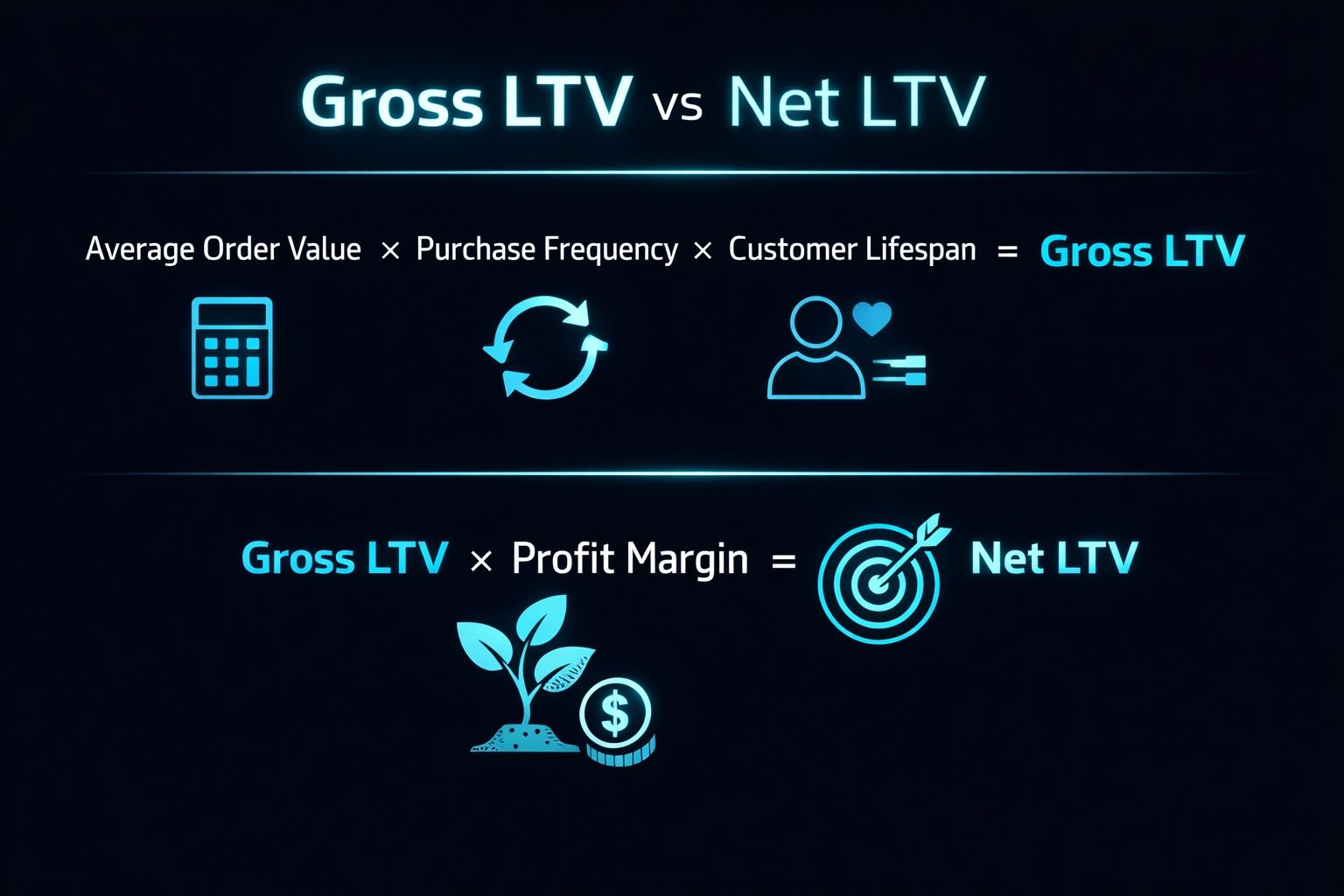
Gross LTV is the total cash a customer hands over.
Net LTV is the money you actually keep after costs.
You need both, but Net LTV should guide your marketing spend.
Here’s the coffee shop example in one clean flow:
- Gross LTV (Vanity): €4 × 2 visits × 52 weeks × 3 years = €1,248 (the total cash they hand over).
- Profit Margin: 70%.
- Net LTV (Sanity): €1,248 × 0.70 = €873.60 (the money you actually keep).
Golden rule: Net LTV = Gross LTV × Profit Margin.
Pro tip (for the math geeks): If you want to be hyper-accurate (especially for subscription businesses), the ‘official’ formula is: LTV = (Monthly Revenue per Customer × Gross Margin) ÷ Monthly Churn Rate.
This formula works best for subscription, SaaS, memberships, or retainer-based businesses.
Churn rate is just the % of customers you lose each month. While this is the most accurate way to do it, the ‘Gross LTV × Margin’ method we used above gets you 95% of the way there without the headache.
Why Most Irish SMEs Get This Wrong
Here's the mistake: most businesses only look at what a customer spends today.
A plumber charges €150 to fix a leak and thinks, "I made €150." But if that customer trusts them for an annual boiler service and calls them back for a few repairs or a small upgrade over the next 7-8 years, that's not a €150 customer—it’s closer to a €1,500+ customer.
When you only see the first transaction, you undervalue your customers. And when you undervalue them, you underspend on keeping them happy.
The math is brutal but honest: Studies consistently show it can cost significantly more — often multiple times more — to acquire a new customer than to retain an existing one. If your LTV is €1,000 but you're spending €200 to win each customer and nothing to keep them, you're leaving money on the table.
The Snowball Effect: Why Consistent Marketing Compounds
Here's where it gets interesting.
Let's say you spend €500 a month on consistent marketing, Google Ads, social posts, a bit of local sponsorship. You win 5 new customers a month with an LTV of €1,000 each.
Month 1: You spend €500, win 5 customers worth €5,000 in lifetime value. Net gain: €4,500.
Month 2: Same thing. Another €4,500.
But here's the magic: those customers from Month 1 are still buying. And the ones from Month 2. And Month 3.
By Month 12, you've invested €6,000 in marketing and acquired 60 customers. At €1,000 LTV each, that’s €60,000 in total value—leaving you with a €54,000 net gain. (In reality, revenue arrives over time and not every customer reaches full lifetime value — but the principle of compounding still holds.)
And many of them are still actively spending.
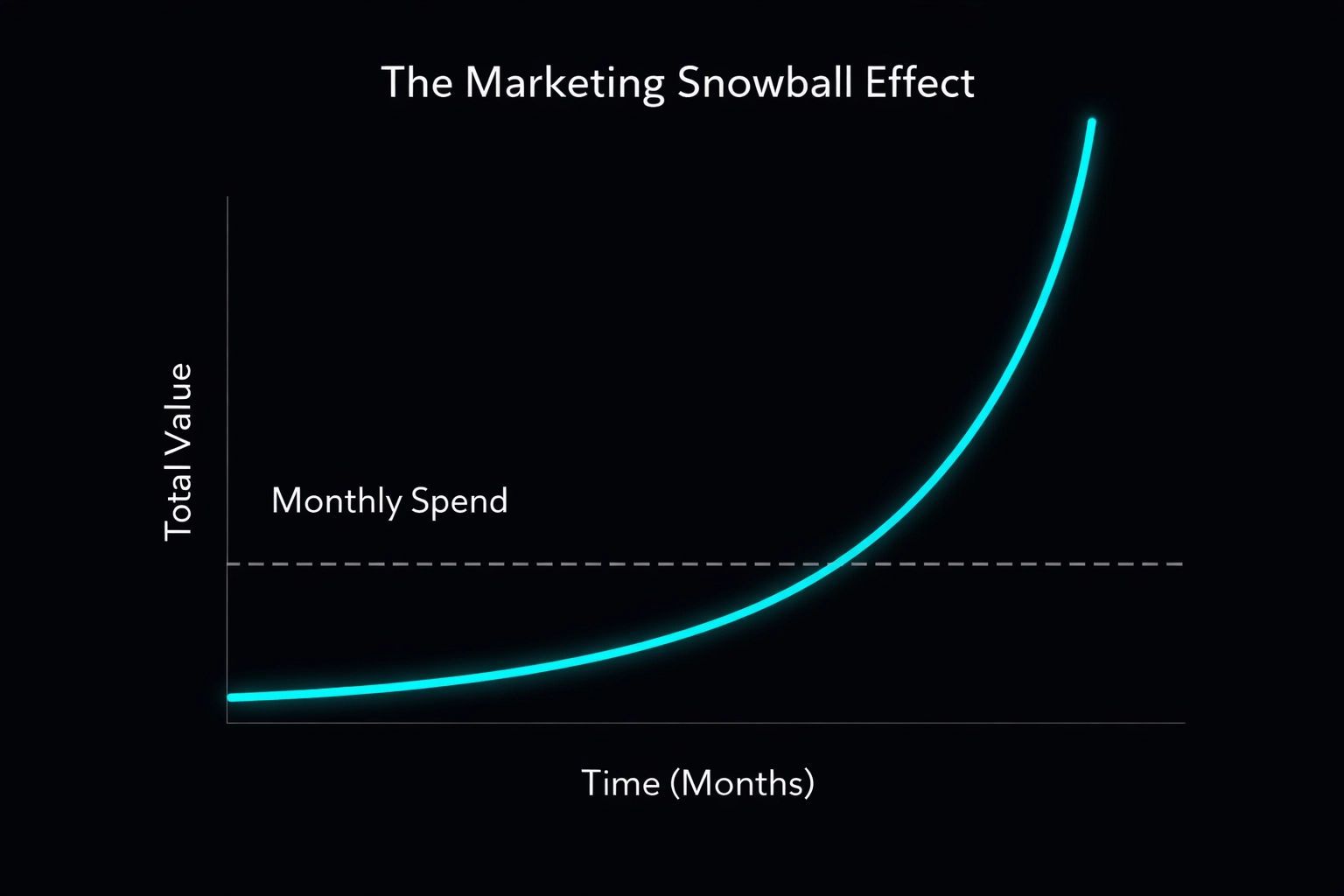
This is the snowball effect. Consistent marketing doesn't just win customers, it builds cumulative value that keeps rolling forward even when you're not actively selling.
Compare that to the business that spends €2,000 in January, wins 20 customers, then goes silent for six months. They get a spike, then nothing. No momentum. No compounding.
The lesson: Small, consistent marketing efforts create long-term customer value that far exceeds sporadic big pushes.
How to Use LTV to Make Smarter Decisions
Once you know your LTV, three things become crystal clear:
1. How Much You Can Spend on Ads
If your LTV is €800 and you're spending €300 to acquire a customer, you're still profitable. But if you're spending €900, you're losing money on every new customer.
The rule of thumb: aim for an LTV that's at least 3 times your Customer Acquisition Cost (CAC).
2. Which Customers to Focus On
Not all customers are created equal. Run the LTV calculation for different customer segments, new vs. returning, online vs. in-store, premium vs. budget.
You'll quickly see which groups are worth the extra effort and which ones are dragging down your average.
💡 One of the best ways to attract those high-value local customers is by mastering the 2026 Ireland Local SEO Playbook to ensure you're found by the right people at the right time.
3. When to Invest in Retention
If keeping a customer happy for one extra year adds €400 to their LTV, spending €50 on a loyalty program or a "thank you" gift becomes an obvious decision.
Retention isn't a nice-to-have. It's a profit centre.
💡 One of the most effective (and cheapest) ways to keep those customers coming back is through a smart strategy. See why Email Marketing still reigns supreme in 2026.
4. The Missing Link: Payback Time
LTV tells you the total value, but it doesn’t tell you the timing.
If it costs you €300 to win a customer worth €1,000, that’s a fantastic return—unless it takes them 24 months to spend enough for you to cover that initial €300.
For many SMEs, cashflow is the real constraint.
Always keep an eye on your CAC Payback Period: the number of months it takes to earn back your initial marketing investment.
Knowing your LTV tells you if you should spend the money; knowing your payback period tells you if you can afford to wait for the return.
A Quick Reality Check for Irish Businesses
If you're running a local business in Ireland, you likely already know your regulars by name. You probably have a gut feeling about who your 'good' customers are.
LTV just puts a number on that feeling. And once you have the number, you can make decisions based on math instead of hope.
Ask yourself these three questions:
- Do I know what my average customer is worth over their lifetime?
- Am I spending enough to win customers if I know their long-term value?
- Am I doing anything to keep those customers coming back?
If the answer to any of those is "no," you're flying blind.
From Thinking to Doing
You don’t need a spreadsheet full of perfect data to start using these concepts. You just need a starting point.
Even a rough estimate of your LTV will fundamentally change how you view your marketing spend. It shifts your focus from 'How much am I losing today?' to 'How much value am I building for tomorrow?'
Start with your best guess, keep an eye on your payback time, and let the math guide your growth. Because the businesses that win in the long run aren't just the ones with the biggest budgets—they’re the ones who know their numbers and have the confidence to play the long game.