Gym Marketing Math: How Two Memberships Pay for Your Entire Digital Strategy
Let's talk about the elephant in the room.
You run a premium training studio. You care about coaching, experience, and results.
But every time you look at marketing prices, your stomach drops.
Over €1,100 a month? That's a lot of kit upgrades. That's a lot of rent. That's money you can actually see.
Digital marketing? That can feel like throwing cash into a void and hoping something happens.
Here's the thing: you're not wrong to be sceptical. But you might be doing the maths wrong.
Important note: What follows is a hypothetical scenario for illustration purposes only. Dave isn't a real person, and this isn't a case study. But the maths? That's very real. And it might just change how you think about marketing spend.
Meet Dave: The Sceptical Gym Owner
Dave runs a Premium Training Studio in Tallaght.
He's got good equipment, loyal members, and a reputation built on word-of-mouth. He's been in the game for five years.
Every few months, someone tells him he needs a "digital presence." Agencies call. Ads pop up promising "10x growth." His mate's nephew offers to "do his socials."
Dave's response is always the same: "I'm not paying over a thousand a month just to get a few likes on Facebook."
And honestly? Fair enough.
But Dave is making one critical mistake. He's thinking about marketing as a cost, not an investment.
Let's fix that.
The One Number That Changes Everything: Lifetime Value
Here's where the napkin comes out.
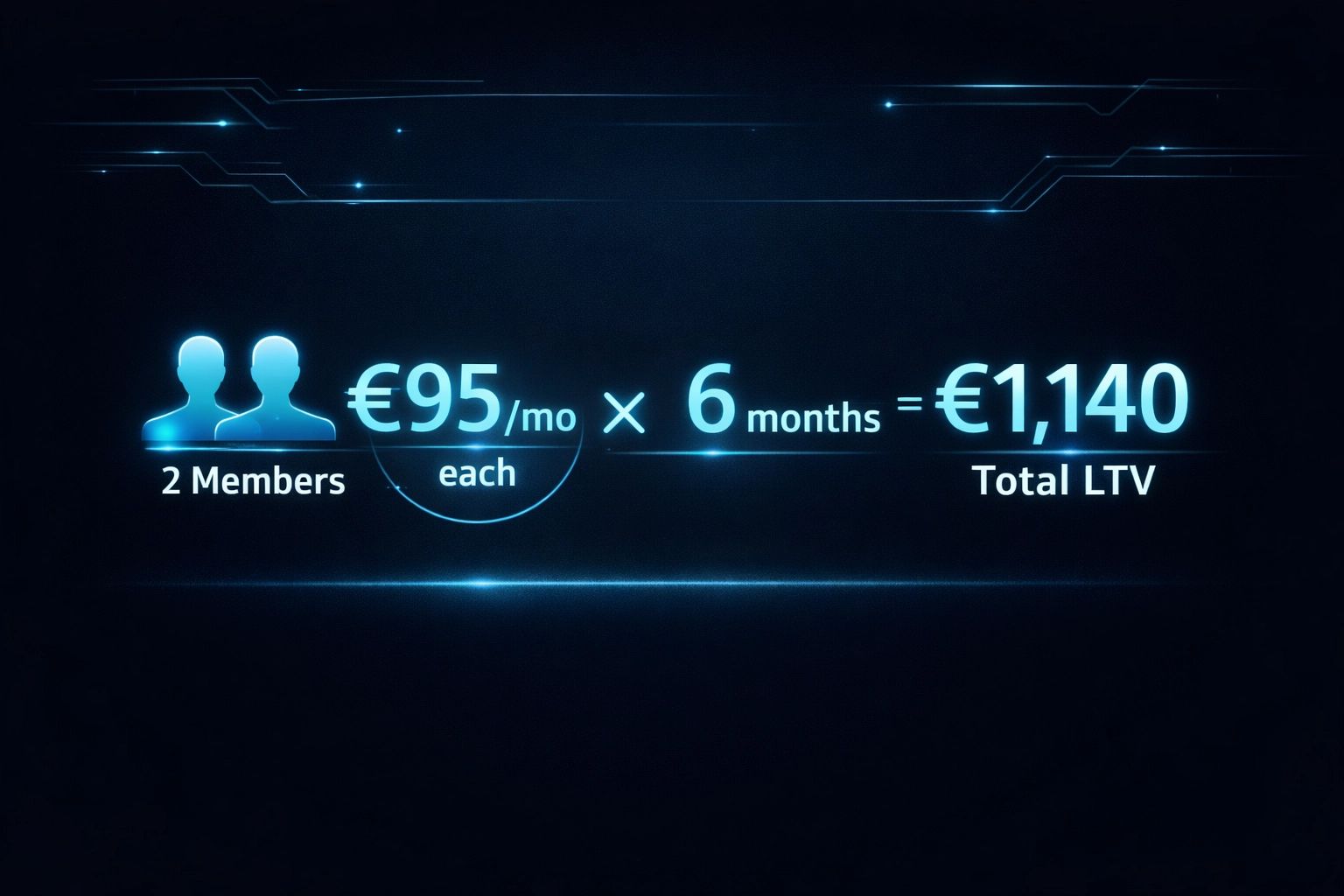
Dave charges €95 per month for membership. That’s typical for a premium studio where you’re paying for coaching, programming, and a higher-touch experience.
Now, how long does the average member stick around?
Industry data varies, but let's be conservative. Say the average member stays for 6 months before they move, lose motivation, or switch gyms.
Here's your first bit of napkin maths:
€95 × 6 months = €570
That's the Lifetime Value (LTV) of a single member.
Not the first payment. Not the signup fee. The total value of that one person walking through your door.
Suddenly, a new member isn't worth €95. They're worth €570.
Important note: This is a simple, hypothetical example for illustration purposes only.
Now Let's Talk About Marketing Costs
Here's where Dave gets nervous.
He's seen agencies quote €2,000 setup fees. He's heard about "percentage of ad spend" models where costs spiral as you grow. He's been burned by a "social media manager" who posted three times and disappeared.
But what if marketing wasn't a gamble?
What if it was a fixed, predictable monthly cost: like your electricity bill or your equipment lease?
Let's say Dave pays a total monthly investment of €1,128 for a simple, consistent growth machine.
That total is split into two clear buckets:
- Ad Spend (paid to Meta/Google): €500/month
- Professional Services (done for you): €628/month
- Hyper-Local SEO: €389/month
- Ad Management: €239/month
No surprise fees. No “we need another €300 for this campaign.” Just €1,128, every month, like clockwork.
(Note: We’ve used these specific figures to keep the math simple and transparent—they happen to be our own standard rates at Spryter. However, the logic remains the same regardless of who you work with. Feel free to swap these out for your own agency quotes or internal costs to see how the math stacks up for your specific studio.)
Now here's the question Dave should be asking:
How many new members do I need to find each month to make this worth it?
The Break-Even Calculation (It's Easier Than You Think)
Let's do the maths.
- Total monthly investment: €1,128/month
- Lifetime Value of one member: €570
If Dave’s marketing brings in two new members per month, the lifetime value of those members roughly covers the monthly investment.
But don’t confuse that with instant cash-flow break-even.
When you sign up two members, you lock in a Lifetime Value of €1,140 against a monthly bill of €1,128.
You’ve essentially bought two €570 assets (total €1,140) for €1,128. It’s an investment in future revenue.
So in month one, Dave spends €1,128 and gains two members worth €1,140.
In month two, he spends another €1,128, gains two other members: but the first members are still paying.
See where this is going?
The Snowball Effect: Where the Magic Happens
This is the part most gym owners miss.
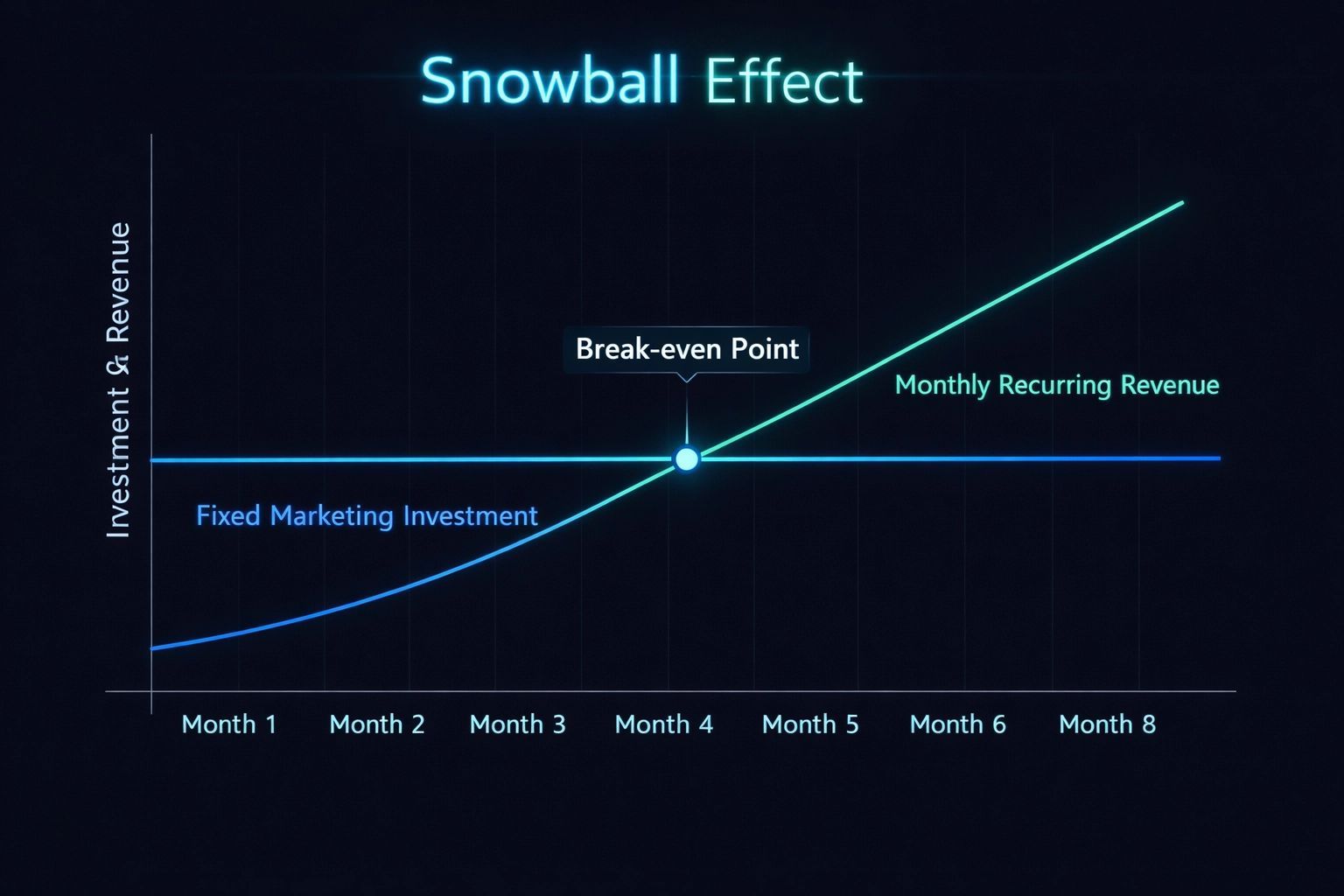
Marketing isn't just about the new members. It's about the accumulation of recurring revenue against a fixed cost.
Important note: The numbers below are a hypothetical, illustrative scenario (not a case study).
Assumptions (for simple napkin maths)
- Marketing cost: €1,128/month (fixed)
- New members: 3 per month (one more than the bare minimum to illustrate the snowball effect)
- Membership price: €95/month
- Average retention: 6 months
Month-by-month breakdown (first 6 months)
Month 1
- Marketing cost: €1,128
- New members: 3
- Total active members from marketing: 3
- Monthly revenue from those members: €285
Month 2
- Marketing cost: €1,128
- New members: 3
- Total active members from marketing: 6
- Monthly revenue from those members: €570
Month 3
- Marketing cost: €1,128
- New members: 3
- Total active members from marketing: 9
- Monthly revenue from those members: €855
Month 4
- Marketing cost: €1,128
- New members: 3
- Total active members from marketing: 12
- Monthly revenue from those members: €1,140
- Break-even reached! The machine is now paying for itself.
Month 5
- Marketing cost: €1,128
- New members: 3
- Total active members from marketing: 15
- Monthly revenue from those members: €1,425
Month 6
- Marketing cost: €1,128
- New members: 3
- Total active members from marketing: 18
- Monthly revenue from those members: €1,710
What that adds up to
- Total marketing spend over 6 months: €6,768
- New monthly revenue by month 6: €1,710/month
- Projected value of those 18 members (LTV): 18 × €570 = €10,260
And that’s assuming only 3 new signups per month — modest for gyms with decent conversion and local demand, but not guaranteed.
By month four, the recurring revenue from those new members alone (€1,140/month) covers the monthly marketing cost (€1,128/month). From that point on, the machine becomes a profit-generator.
Why Fixed Pricing Beats the "Big Agency" Model
Here's something Dave didn't realise until he did the maths.
Some agencies charge a percentage of your ad spend. Others take a cut of your revenue growth. That sounds fair: until you're successful.
Imagine Dave's gym takes off. He's bringing in 10 new members a month. Under a commission model, his marketing costs increase as he grows.
With a fixed subscription? His costs stay the same.
More growth = more profit. Not more fees.
That predictability matters for small Irish businesses. You can budget for it. Plan around it. Sleep at night knowing exactly what's leaving your account.
But What If It Doesn't Work?
Fair question. Dave asked it too.
Here's the honest answer: not every marketing strategy works for every business. That's true.
But here's what the maths tells us:
If you’re paying €1,128/month and your LTV is €570, you only need two members per month to break even.
Even if results are slower than expected, the numbers can still work in your favour over time. And if it's good? The snowball builds fast.
The risk isn't in trying digital marketing. The risk is in not doing the maths before you decide it's "too expensive."
What Dave Did Next
In our hypothetical scenario, Dave stopped thinking about marketing as a "nice to have."
He started treating it like equipment.
When he bought a new squat rack, he didn't expect it to pay for itself in week one. He knew it would attract members, keep them happy, and generate revenue over years.
Marketing is the same. It's infrastructure. It's the thing that keeps the phones ringing and the doors opening.
Dave ran the numbers. He picked a predictable, subscription-based approach. And he stopped losing sleep over "wasted" ad spend.
Because it wasn't wasted. It was invested.
Your Turn: Run the Numbers
Grab a napkin. Or a spreadsheet. Or the back of a receipt.
Write down:
- Your average monthly membership fee
- How long the average member stays
- Multiply those together (that's your LTV)
- Divide your potential marketing cost by that number
That's how many members you need to break even.
For most small gyms in Ireland, the answer is shockingly low.
And once you see that number? The "expense" starts looking like an opportunity.
Speed vs. Sustainability
You want results fast. That’s normal.
Ads give you speed.
They can start driving enquiries this week, as long as you keep funding the budget.
Hyper-Local SEO gives you sustainability.
It takes time, but it builds visibility that keeps working even when you’re not pushing spend as hard.
Use both and you stop guessing.
Ads bring predictable short-term leads, while Hyper-Local SEO builds long-term dominance in your area.
Over time, that local dominance usually lowers your customer acquisition cost because more people find you through “near me” searches without you paying for every click.
A Quick Reality Check
Let’s be real for a second: these numbers are simplified to keep the maths clean.
In the real world, things like your location, your specific offer, and how well you close enquiries will shift the needle. Retention isn't always a perfect 6 months (although this number is fairly conservative), and conversion rates aren't a flat line.
But don’t get bogged down in the decimals. The takeaway isn’t the exact Euro amount—it’s the framework. If the lifetime value of a single member is higher than your monthly marketing bill, the economics are on your side. The rest is just scaling.
The Bottom Line
Digital marketing isn't magic. It's maths.
And the maths says this: if you can find two loyal premium members per month through your online presence, you’re already covering the whole machine.
The real question isn't "Can I afford to market my gym?"
It's "Can I afford not to?"